Description
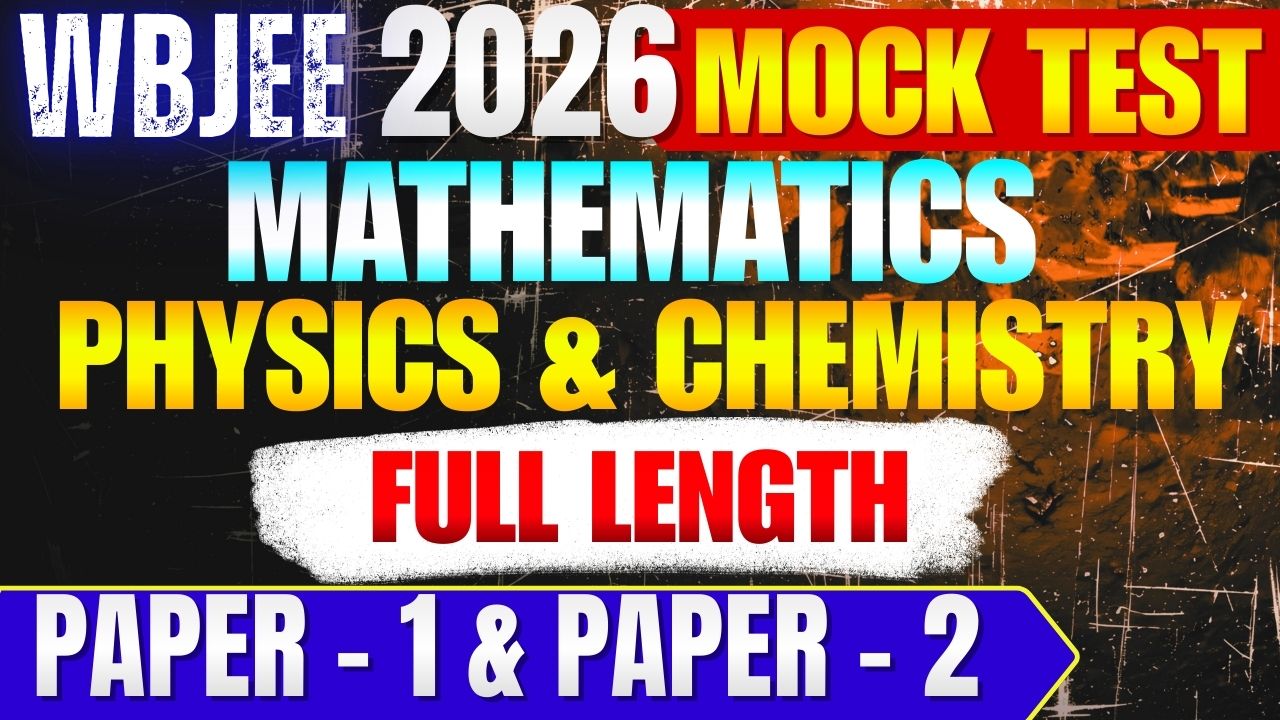
To excel in the WBJEE (West Bengal Joint Entrance Examination) Mathematics paper, a mock test must mirror the unique structure and difficulty level of the actual exam. Unlike many other entrance tests, WBJEE places a heavy emphasis on speed, accuracy, and a specific three-category marking system.
Below is a detailed breakdown of what a comprehensive Mathematics Mock Test includes.
1. Exam Structure & Marks Distribution
The Mathematics paper is the first session of the WBJEE and is arguably the most critical for securing a high rank. A full-length mock test consists of 75 questions totaling 100 marks, divided into three distinct categories:
| Category | Number of Questions | Marks per Correct Answer | Negative Marking |
| Category 1 | 50 Questions | +1 | -1/4 (0.25) |
| Category 2 | 15 Questions | +2 | -1/2 (0.50) |
| Category 3 | 10 Questions | +2 | Zero (Multiple Correct) |
Note on Category 3: These are multi-select questions. No marks are deducted for incorrect choices, but partial marks are awarded only if all correct options (and no incorrect ones) are selected.
2. Core Syllabus Coverage
A high-quality mock test ensures proportional weightage based on previous years' trends. Key areas include:
-
Algebra: Complex Numbers, Quadratic Equations, Determinants & Matrices, Probability, and Permutations & Combinations.
-
Calculus (High Weightage): Limits, Continuity & Differentiability, Integration (Definite & Indefinite), and Differential Equations.
-
Coordinate Geometry: Circles, Parabola, Ellipse, and Hyperbola.
-
Trigonometry: Inverse Trigonometric Functions and Trigonometric Equations.
-
Vectors & 3D Geometry: Often considered the "scoring" section of the paper.
3. Critical Features of the Mock Test
To simulate the real exam environment, the mock test focuses on three pillars:
A. Time Management
You have 2 hours (120 minutes) to solve 75 questions. This means you have roughly 96 seconds per question. The mock test is designed to train you to identify "easy" kills versus time-consuming "traps."
B. Difficulty Grading
-
Easy (30%): Direct formula-based questions to build confidence.
-
Moderate (50%): Requires logical application and multi-step calculations.
-
Hard (20%): Conceptual depth similar to JEE Advanced, usually found in Category 2 and 3.
C. The "Category 3" Strategy
The mock test provides specific practice for multi-choice questions where the strategy shifts from "solving" to "eliminating" incorrect options to secure partial marks.
4. Post-Test Analysis
The value of a mock test lies in the review. A detailed solution set should provide:
-
Step-by-step derivations for complex calculus problems.
-
Shortcuts and Tricks for Algebra and Coordinate Geometry to save time.
-
Success Analytics: Identifying which chapters took the most time and where the most negative marks were incurred.